Showing posts with label Yankees. Show all posts

Wednesday, September 5, 2018

The 47 Best Players from the 1998 Chicago Cubs - #2 Kerry Wood

2. Kerry Wood
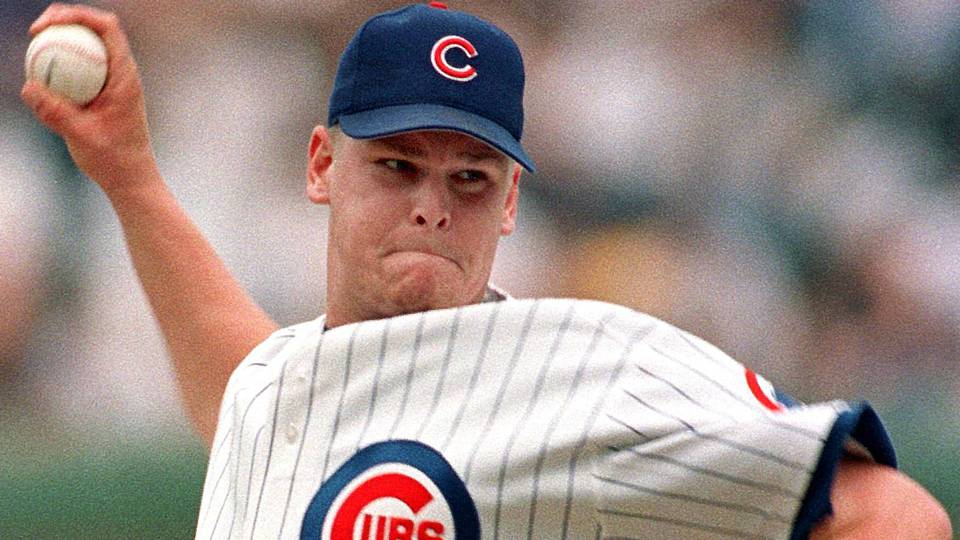
Holy shit, Kerry Wood was good. Like, it is not nearly appreciated enough how good Kerry Wood's stuff was as a pitcher. Here's how good he was. Kerry Wood was a SURE THING when he was called up to the major leagues. Nobody doubted that he would be awesome. This was despite the fact that between Double-A and Triple-A the previous year, he had a 4.57 ERA and walked nearly EIGHT batters per nine innings. He most definitely needed some more seasoning in the minor leagues, and the Cubs gave it to him, with a single start in Iowa where he struck out 11 batters in five innings.

Kerry Wood did not come out and set the world on fire immediately. After giving up seven runs in less than two innings, his ERA was sitting at 8.74 after three starts. Of course, he followed that up with his best start so far, going seven innings and giving up just one run against the Cardinals.

Then he faced the Astros on May 6. There's not a whole lot I can say about this game that hasn't been said multiple times before. Here are a couple fun facts. The first eight batters struck out that day as Shane Reynolds also struck out the side in the first inning. Starting in the seventh inning, when Kerry Wood should have been slowing down, he struck out seven straight batters. The Astros heart of their lineup, 3-4-5 hitters, Jeff Bagwell, Jack Howell, and Moises Alou had nine at bats and struck out nine times. It's the greatest game ever pitched as far as I'm concerned as there is a very solid argument that on top of the 20 strikeouts, he also should have had a no hitter. Also, just to prove it wasn't a fluke, Wood struck out 13 Diamondbacks in his next start.

Let's just take a break to watch some gifs, because even if you've seen these 1000 times, they are still mesmerizing.


Poor Derek Bell. With only seeing one batter go down before him, he had no idea what he was in store for, and it showed as he missed so bad that he had to jog forward to avoid face planting on home plate.


It's not just that Jeff Bagwell's knees buckle but the total disdain he has as he walks off on shame that truly makes it beautiful.


Look at poor Dave Clark. He's all confident, getting ready to make good contact with a pitch, and then he realizes that the pitch is diving a foot below his swing plane, but by that point, it's already too late. I mean, just look at that poor man's face.


Brad Ausmus probably made the wise decision to just keep the bat on his shoulders for this one. But most importantly, if you look up at the information box in the upper left corner, you can see that this pitch was so nasty that they gave Wood two strikes for it. That's pretty damn impressive.


When Bill Spiers heard Larry Dierker call his name to go in and pinch hit, do you think he tried to pretend he couldn't hear him? I would have definitely tried that if I was Bill Spiers. He should have stuck two fingers down his throat, started puking, and just not had to deal with this. As for the pitch, it looks like it almost hits Spiers right elbow and also his left hip. It never comes close to hitting Spiers's bat though.


This is the final strikeout of the game. Not only did Derek Bell get made to look silly again, but even Kerry Wood has earned a subdued fist pump to celebrate.

Okay, I guess I did still have a few things to say about that game.

After his two-start, 33 strikeout run, he would continue to dominate, striking out at least 10 batters seven more times. His most impressive outing was August 26, his second-to-last start of the regular season, when he struck out 16 Cincinnati Reds batters in eight innings.

He would go 13-6 with a 3.40 ERA and led the league in strikeouts per nine innings since he had an incredible 233 in 166 innings. His 12.5 beat second-place Curt Schilling by more than 2.5 strikeouts per nine innings. He also won the Rookie of the Year award, barely edging out Todd Helton.

Although Wood did not pitch the final month of the season, he did come back for the playoffs, giving up just one run in five innings, but the bullpen promptly let the Braves blow the game wide open.

Wood didn't make a single appearance the next season as he had to have Tommy John surgery before the 1999 season. It's not too surprising as the 20-year-old eclipsed 100 pitches in 21 of his 26 starts in 1998. In 2000, it looked like he may never reclaim the magic he showed his rookie year as he put up a 4.80 ERA in 137 innings.

But then, 2001-2003, he turned things around, pitching about 200 innings with an ERA in the mid-to-low 3s while striking out over ten batters per nine innings. Unfortunately, it was not made to last as he took a small step back in 2004, and by 2005, he was forced to try a transition to the bullpen.

If you were following the Cubs back then, you probably resigned yourself to the fact that Kerry Wood would never be productive again. No matter what he did, he could not stay healthy long enough to get in a groove to be a reliable member of the pitching staff. Between 2006-2007, he pitched just over 40 innings combined.

But in 2008, he reinvented himself as a successful closer for the team, racking up 34 saves. The Cubs didn't believe the magic was real and allowed him to go to the Indians in 2009, not even making an offer for Wood to stay. he was solid for the Indians in 2009, then struggled with them in 2010 before being traded to the Yankees where he dominated as a setup man for Mariano Rivera, putting up the nicest ERA of 0.69. He came back to the Cubs in 2011 and was effective again in relief. But in 2012, it fell apart, and he would retire later that year.

Kerry Wood is the most exciting pitcher in Cubs history. He's not the best, but Kerry Wood in 1998 was appointment viewing. Considering he struck out 20 guys in his sixth start, every start after, you came in with the thought that it might be possible again. Information about how pitch counts weren't really out there, at least not for me during my early teenage years, so you didn't really care if he was racking up 120 pitches while striking out 13 guys in seven innings. It was just awesome every time you saw somebody massively whiff on a breaking ball. Kerry Wood was the shit.

And somehow, his story is only the second most important from the 1998 Chicago Cubs.

In case you missed it:
Introduction
#47 - Matt Karchner
#46 - Jose Nieves
#45 - Rodney Myers
#44 - Justin Speier
#43 - Tony Fossas
#42 - Kennie Steenstra
#41 - Chris Haney
#40 - Bob Patterson

#39 - Pedro Valdes

#38 - Derrick White
#37 - Ben Van Ryn
#36 - Terrell Lowery
#35 - Don Wengert
#34 - Kurt Miller
#33 - Jason Maxwell
#32 - Kevin Foster
#31 - Mike Morgan
#30 - Felix Heredia 
#29 - Jeff Blauser
#28 - Jason Hardtke
#27 - Dave Stevens
#26 - Manny Alexander
#25 - Marc Pisciotta
#24 - Kevin Orie
#23 - Sandy Martinez
#22 - Terry Adams
#21 - Matt Mieske
#20 - Amaury Telemaco
#19 - Tyler Houston
#18 - Geremi Gonzalez
#17 - Orlando Merced
#16 - Scott Servais
#15 - Mark Clark
#14 - Lance Johnson
#13 - Brant Brown
#12 - Jose Hernandez
#11 - Steve Trachsel
#10 - Henry Rodriguez
#9 - Kevin Tapani
#8 - Mickey Morandini
#7 - Gary Gaetti
#6 - Rod Beck
#5 - Terry Mulholland

#4 - Glenallen Hill

#3 - Mark Grace

Thursday, August 30, 2018

The 47 Best Players from the 1998 Chicago Cubs - #4 Glenallen Hill

4. Glenallen Hill
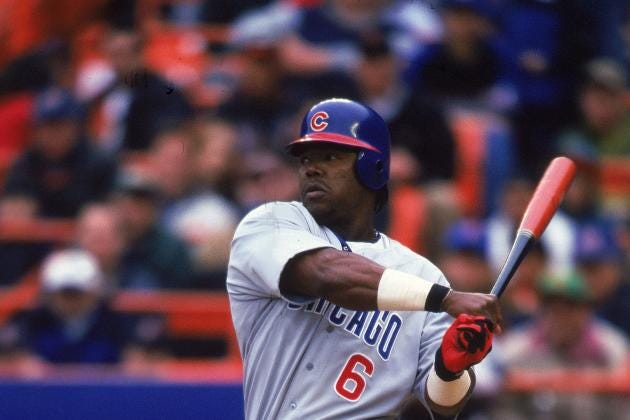
Objectively, Glenallen Hill is too high on this list. But this is not a list of WAR contributions. There has to be some subjectivity involved, and subjectively, it is really tough to find a cooler member of the 1998 Chicago Cubs than Glenallen Hill.

Hill is a guy who bounced around, starting in Toronto, heading to Cleveland, then to the Cubs for his first stint in 1993, over to the Giants, followed by the Mariners, back to the Cubs in 1998, before stops with the Yankees and Angels before wrapping up his career. But let's just focus on that second stint with the Cubs that started in 1998 when the Cubs selected him off waivers from the Seattle Mariners.

He would put up eight home runs with a line of .351/.414/.573, and he hit a nearly unbellievable .459/.524/.973 at home. I wouldn't believe those numbers if it were anyone but Glenallen Hill. As great as those numbers are, Hill has his place this high on this list because of how he got to those numbers. This man, more than any other player in baseball history, crushed baseballs like no other.
Good God, that is a thing of beauty. You can tell just by how hard he hits and how confidently he drops the bat that not only was it a home run, but there was now way the friendly confines of Wrigley Field were going to keep that ball within its premises. He crushed it to the street, because that's just what Glenallen Hill did.

Since baseball is awful at YouTube, let's look at a home run from 2000 since it is probably what Glenallen Hill is most remembered for.

I'll be honest. If Glenallen Hill had hit that home run in 1998, he might have been number two on this list.

Somehow, since the Cubs felt it necessary to challenge my fandom, Glenallen Hill only played in Game 2 of the NLDS. He went 1-3 which made him one of the Cubs best hitters during the playoffs. In the top of the tenth inning, he made his impact felt even more when he led off the inning and did this.
At first, he takes the base because he knows it was what was good for the team, but after walking a few feet down the line, he gives the pitcher a look as if to say, "You just made the best decision of your life by not giving me something in the strike zone." Even though Hill couldn't make an impact with his bat in extra innings, he wasn't going to let Braves pitchers off easy.
This big, burly man stole third base in extra innings of a tied game, and who could blame him? It's not like he could trust Jeff Blauser to knock him in. Hill made it so all Blauser had to do was put the ball in play and he could score. Blauser, of course, struck out, and Mickey Morandini was called out at second base for a strike out double play to end the inning.

That following year with the Cubs, he hit .300/.353/..581. In 2000, he split time with the Cubs and Yankees and hit .293/.336/.600. He went to the Angels in 2001 and 16 poor games was enough for the entire league to decide he didn't deserve a spot on an MLB roster anymore.

Most importantly, I was able to meet Glenallen Hill at a Cubs convention before the 2004 season. They had a dual signing with him and Kevin Tapani, so I was more excited for this than any sexual encounter I have experienced. First was Tapani, and I expressed that the 1998 team was my favorite team of all-time, and he kind of blew me off. Whatever, Kevin Tapani, your ERA was a far better indicator of your performance than your win-loss record. But then, I told Glenallen Hill the same thing, and he replied, "Man, if we would have beat the Braves, we would have won it all." I KNOW, GLENALLEN HILL, And that is why I am still proclaiming it 20 years later. Glenallen Hill is the coolest player in baseball history, and nobody will ever convince me otherwise.

In case you missed it:
Introduction
#47 - Matt Karchner
#46 - Jose Nieves
#45 - Rodney Myers
#44 - Justin Speier
#43 - Tony Fossas
#42 - Kennie Steenstra
#41 - Chris Haney
#40 - Bob Patterson

#39 - Pedro Valdes

#38 - Derrick White
#37 - Ben Van Ryn
#36 - Terrell Lowery
#35 - Don Wengert
#34 - Kurt Miller
#33 - Jason Maxwell
#32 - Kevin Foster
#31 - Mike Morgan
#30 - Felix Heredia 
#29 - Jeff Blauser
#28 - Jason Hardtke
#27 - Dave Stevens
#26 - Manny Alexander
#25 - Marc Pisciotta
#24 - Kevin Orie
#23 - Sandy Martinez
#22 - Terry Adams
#21 - Matt Mieske
#20 - Amaury Telemaco
#19 - Tyler Houston
#18 - Geremi Gonzalez
#17 - Orlando Merced
#16 - Scott Servais
#15 - Mark Clark
#14 - Lance Johnson
#13 - Brant Brown
#12 - Jose Hernandez
#11 - Steve Trachsel
#10 - Henry Rodriguez
#9 - Kevin Tapani
#8 - Mickey Morandini
#7 - Gary Gaetti

#6 - Rod Beck

#5 - Terry Mulholland

Tuesday, August 7, 2018

The 47 Best Players from the 1998 Chicago Cubs - #14 Lance Johnson

14. Lance Johnson
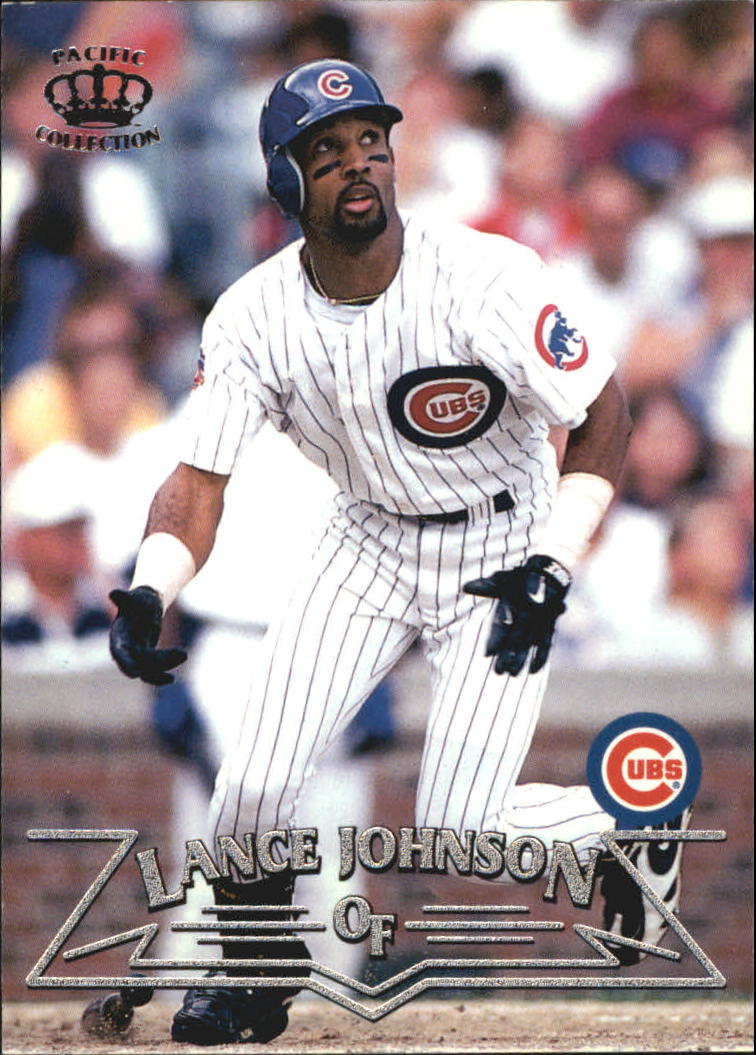
Even before he was a Cub, Lance Johnson was always a player I really liked despite him most notably playing for the crosstown rival, Chicago White Sox. Hell, I didn't even find it aggravating when White Sox announcers would refer to him as One Dog. As an undersized guy my entire life, I appreciated Johnson being only 5'10" and 160 pounds since that is about my current adult size. Could I make a run at the major leagues? It's not impossible, just need to gain hand-eye coordination, the ability to swing a baseball bat, and not have a noodle arm.

Helping my case is that Johnson weirdly got better into his early 30s and put up his best numbers in 1996 for the New York Mets at the age of 32 where he hit 21 triples, stole 50 bases and led the league in hits. In 1997, his numbers he was nearly as good, but the Mets traded him to the Chicago Cubs in a deal where each team exchanged two pitchers and a center fielder (Brian McRae going to the Mets).

The Cubs thought they had a center field solution with Johnson, but early on, that did not appear to be the case. On April 27th, he was hitting .115, and then he went down with an injury that would keep him out until the All-Star break. And although that was a mighty hole to dig out of, Lance did everything he could to make a positive impact. It took him until August 18 to get his average above .200, but that average just kept rising as the season went on.

He caught fire in September as he hit .345/.395/.491 to give him a very respectable final season line of .280/.335/.352 by the end of the season. But even though he was only able to play in 85 games, Lance Johnson came through down the stretch.

In Game 163 against the San Francisco Giants, he led off the sixth inning with a single and would help extend the Cubs lead. He also received all three starts in the playoffs but was unable to keep the hot hitting going as he had just two hits in 12 at bats.

Health was Johnson's downfall as he could not stay healthy in 1999 and his numbers began to drop off. He signed with the Yankees as a free agent for the 2000 season, but only played in 18 games before washing out of the big leagues for good.

But Lance Johnson was just a cool player. He was small, super fast, and the man barely believed in doubles as he was always trying to stretch them into triples. Even with the White Sox, he was fun to watch, but I am glad that I got to cheer for him while playing for the Cubs, even with injuries limiting his time. A guy like Lance Johnson gave you hope. Now it's time for me to hit the batting cages.

Tuesday, July 3, 2018

The 47 Best Players from the 1998 Chicago Cubs - #30 Felix Heredia

30. Felix Heredia
When it comes to Felix Heredia, I can't separate him from the heartbreaking trade that got him here. As I have probably mentioned a couple dozen times by now, the Cubs bullpen was absolutely terrible. At the trade deadline, the Cubs had to do anything they could to make things happen in the bullpen. So they traded one of my favorite Cubs, Kevin Orie (along with Justin Speier) in order to acquire Felix Heredia.

I was heartbroken. I loved Orie, despite him somehow performing worse than the Cubs bullpen did in 1998, I still believed. And to only get Heredia in return? A guy with an abysmal 5.49 ERA? How could the Cubs do this to me?

As bad as I thought the trade was, the Cubs needed to do anything they could to help the bullpen, and Kevin Orie was not going to help that team in 1998. In August, Heredia's first month with the team, he was doing everything he could to make me hate him. On August 27, his ERA rose to 6.97, and I cursed him every time he entered the game.

Somehow, on August 28, he turned things around. His ERA went down to 6.75, then 6.55, 6.35, and it just kept dropping. He had 15 appearances over the next month and didn't allow a single run, dropping his ERA to a totally acceptable 4.08. He even gave the Cubs a scoreless 1/3 of an inning in the playoff elimination game against the Giants. He was the hottest relief arm on the Cubs staff.

So it was no surprise when he came in during Game 1 of the NLDS with a runner on and no outs and the Cubs down by just two runs. He manged to get an out on a failed bunt attempt before walking the next two batters. After the bases were loaded, the Cubs went to trusted relief specialist, Matt Karchner, who promptly gave up a grand slam. The Cubs would not come back to win that game, and Heredia would not pitch again in the playoffs.

Heredia would never relive that September magic but stayed with the Cubs for three more years of painful performances where he recorded 4.85, 4.76, and 6.17 ERAs. The Cubs sent him to the Blue Jays in 2002 in a trade for Alex Gonzalez and managed a 3.61 ERA. Then, he was even better in 2003, putting up a 3.00 ERA for the Reds before being traded to the Yankees and putting up a 1.20 ERA in 15 innings while striking out 2.4 batters per 9 innings.

It rightfully fell apart in 2004 where his ERA was back over 6.00, and then he would pitch just 2.2 innings after that year before bouncing around the minors and various international leagues until 2008 when he retired. Although he came up known as El Gato Flaco, The Skinny Cat, he ended his career with a different nickname, The Run Fairy. He wasn't bad enough to truly earn that nickname, and he was definitely better than this low of a spot on this list, but much like I learned when the Cubs traded away Kevin Orie, life isn't fair sometimes.

In case you missed it:
Introduction
#47 - Matt Karchner
#46 - Jose Nieves
#45 - Rodney Myers
#44 - Justin Speier
#43 - Tony Fossas
#42 - Kennie Steenstra
#41 - Chris Haney
#40 - Bob Patterson

#39 - Pedro Valdes

#38 - Derrick White
#37 - Ben Van Ryn
#36 - Terrell Lowery
#35 - Don Wengert
#34 - Kurt Miller
#33 - Jason Maxwell

#32 - Kevin Foster

#31 - Mike Morgan

Thursday, May 31, 2018

The 47 Best Players from the 1998 Chicago Cubs - #43 Tony Fossas

43. Tony Fossas
Tony Fossas had a fascinating career. His time with the Cubs was less fascinating, but this is a man who pitched until he was 41-years-old. Even more fascinating is that he didn't make his major league debut until he was 31.

Think about that. This man spent a decade in the minor leagues, realizing that his time for a callup had probably already passed. He bounced around to many organizations, including the Cubs in 1985, but never made the show. But he kept showing up. Kept throwing strikes, and the Rangers gave him a goodwill callup during the 1988 season. They didn't even bother resigning him after the year, but he'd bounce around from organization to organization again, only this time, he found himself on major league rosters as a lefty specialist, a role that didn't even exist during his years in the minor leagues. That's incredible.

And a career that incredible must also have some pretty incredible highlights. I'm glad you asked, because I sure have a doozy for you.

That's not him that messes up and fields a fair ball while waiting in the bullpen, but he is the guy who shows up over his right shoulder to show his disdain for his teammate. That's a veteran move right there.

As for his run with the Cubs, I was going to say his most exciting contribution was pitching both ends of a doubleheader against the New York Mets. He pitched an inning in the early game, and then 1/3 of an inning in the second game, both without giving up an earned run. The key word there is earned, as in the second game, he came in with the bases loaded with two outs. He allowed all three inherited runners to score, turning a one-run defecit into a four-run hole. But, none of those runs were earned.

Overall, he pitched just four innings for the Cubs and gave up four runs in that time before the Cubs released him. After that, he caught on with Texas where he pitched 7 1/3 scoreless innings for the Rangers. This was enough for the Yankees to sign him as a 41-year-old in 1999. He pitched in five games for the Yankees, totaling a single inning in those appearances while giving up four runs for a 36.00 ERA.

Tony Fossas was an OG LOOGY. He literally started his career during a time where that wasn't a thing, hung around the minors for ten years and let it become a thing, and then filled that role for a ten-year major league career. Sometimes, he was great in that role, other times he was acceptable, and at the end, he was a tad bit brutal. But you look at a career like his, and you can't help but have a little hope for the future. It's not too late to live your dream, and Tony Fossas is living proof of that.

In case you missed it:
Introduction
#47 - Matt Karchner
#46 - Jose Nieves

#45 - Rodney Myers

#44 - Justin Speier

Tuesday, March 7, 2017

2017 Fantasy Baseball Sleepers - AL East

Although baseball season is still a few weeks away, fantasy baseball season is here as draft rooms are opening and people are spending fake auction dollars on their favorite players. Everybody knows about the Mike Trouts and Clayton Kershaws of the world, so what you need to do stand out is find those hidden gems on each roster to propel yourself to fantasy greatness. I am going to go through each MLB roster to find at least one underrated player who will have you looking like a genius at the end of the season.

Today, after going with the less sexy divisions in the American League, we go with the most talked about division in all the land, the AL East.

Baltimore Orioles - Dylan Bundy
I've been all-in on Dylan Bundy since he was drafted in 2012, so the fact that I can still buy low on him excites me. He's probably not going to be the game changing pitcher I expected when he was blowing through every minor leaguer that stood in front of him. Due to injuries, he's a different pitcher, but he's still shown that he could be a very good pitcher. Even though he struggled more as a starter in the second half, he was still striking out over a batter an inning, and he's still building up his strength after coming back from injuries. Right now, he's a ranked as a late round flyer, but I think he can produce a mid 3 ERA with a strikeout per inning which wouldn't be a bad haul for a final round pick.

Boston Red Sox - Eduardo Rodriguez
It's damn near impossible to find an underrated Red Sox player. I mean, even Pablo Sandoval made the top 300. Hanley Ramirez ranked 69 which is nice. Maybe I could take a flyer on their top prospect, Andrew Benitendi, but he's already ranked ahead one of the greatest hitters ever, Albert Pujols, so yeah, I can't really say he's underrated. Let's go with Rodriguez who struggled at the beginning of the year but basically pitched like a number two starter in the second half of the season. I doubt he'll be quite that good, but if he gets anything close to that, then he'll be worth it.

New York Yankees - Gary Sanchez
I know this isn't a deep sleeper or anything, but it was the only way I could avoid recommending Chris Carter (I always recommend Chris Carter). I know he's ranked as the second best catcher, but he was only at 113 overall, and that seems at least 30 spots too low. I don't think he's Catcher Babe Ruth, but he's still damn good, and considering the lack of options at catcher, he's worth going above his ranking to go out and secure his services for the year.

Tampa Bay Rays - Jake Odorizzi
Odorizzi's only real issue last year was health, and before that, he had proved to be rather durable. The split may put some extra strain on his arm, but considering the strong track record, he's a pitcher I'd like to have this year. Computer projections continue to love the Rays, so eventually they're going to have to be right...right?

Toronto Blue Jays - Troy Tulowitzki
Making a case with my head for Tulowitzki isn't the easiest. He has been a disappointment since getting traded from Colorado to Toronto. Still, he wasn't too bad last year as he hit 24 home runs, and had he had a better BABIP, he could have easily raised his batting average 20 points. That's what I see happening this year as a little better luck gets him closer to his former glory although not quite all the way there. Is this my head talking? No, but the heart wants what the heart wants. 

Tuesday, July 26, 2011

The Mariners Should Not Trade Felix Hernandez

I do not understand why every time that it is a trading season in baseball, people suggest that the Mariners should trade Felix Hernandez for prospects. Are the Mariners good right now? No, they are not good right now. Should they be looking towards the future? Yes, I think it's time to look towards 2012 and beyond, but this does not mean that giving up Felix Hernandez is a good idea.

First off, what kind of haul would make it worth their while? At first thought, people would think that Manny Banuelos, Dellin Betances, and Jesus Montero would be a great haul for the Mariners. But would it really? You're looking at two pitching prospects who always have the potential to break down and a hitter whose power has disappeared and if he improves his mobility, he might be able to play poorly at first base.

Does that sound like something the Mariners would want to do? No, that sounds like a ridiculously bad return for possibly the best pitcher in baseball. Yes, you can dream on prospects, but you don't have to dream on King Felix, because he's already awesome. And as great as building towards the future sounds, guess what? King Felix can help the Mariners in the future as well. The Mariners are not some small market team; they're owned by the same guys that own Nintendo, so if they need money, they've probably invented a real life Mario that can shit out gold coins.

On top of all of this, Felix is a goldmine for the Mariners as they have a whole section dedicated to his awesomeness every time he pitches. And he's a part of my favorite team commercial ever:

And when teams trade superstars, they almost always come out losers. Yes, the Rangers did do a hell of a job trading away Mark Teixeira to the Braves, but that is an exception, and I certainly wouldn't want to be the team that was betting on it happening again.

I realize there's this belief that every team that isn't the Yankees or Red Sox will lose their best players to those teams. Sometimes this is true, but when you have a generational talent like Felix Hernandez, you do not even think about trading him unless he makes it clear that he will not be resigning with the team. Judging by the fact that he is currently signed through 2014, I don't think they have much to worry about at the moment.

Long live Larry Bernandez.

-Joe

P.S. Since I'm talking baseball, here is an excellent article about the Braves' Brooks Conrad.

Tuesday, March 22, 2011

Why Everybody Hates Iowa Wrestling

Yesterday, I mentioned that the Iowa Hawkeyes are the most hated wrestling team in the nation.  For those that don't follow the sport of wrestling, you're probably wondering how a simple school from the heartland could be so hated by every other wrestling fan.  Well, for the average wrestling fan, it's super simple, Iowa is better than everybody else.  They go out and kick everybody's ass.

For people who follow wrestling a little bit closer, they might hate Iowa because they perceive Iowa as a dirty team.  It's tough to say they aren't.  They often give up points for unsportsmanlike conduct.  At Nationals, they not only gave up match points for unsportsmanlike conduct, but lost two team points for behavior from their coach and one of their wrestler's.

And if you're a hardcore wrestling fan, you probably look at Iowa as being a bunch of assholes.  If you ever watch an interview where an Iowa wrestler wins a decision, the wrestler will act as if he did terrible and say that he should have been more aggressive and gotten bonus points.  If he gets a major decision, he believes it should have been a tech fall.  If he gets a tech fall, he believes he should have pinned the guy.  And if he pins the guy, he says he should have done it quicker.  No matter what Iowa achieves, they always want more.  If a fan of another team sees an Iowa guy beat their guy, followed by the Iowa guy complaining about how he should have done better, I could see how that might irritate people. 

So Iowa wins all the time, they use questionable tactics, and winning isn't good enough for them, because they are always searching for annihilation.  The three reasons that people hate Iowa are the three reasons that I love Iowa.

The first and last reasons are easy to love, winning is awesome.  And winning big is even more awesome.  I could understand how people would compare the Hawkeyes with the Yankees where it can't be that fulfilling to win championships when it happens so frequently.  Well, there are two major differences with that argument.  The first is that the Yankees have a competitive advantage with their payroll to help them win championships.  Iowa is still just Iowa.  It's rare for Iowa to have the top recruiting class, but they win because they get wrestlers who are willing to put in the work to become champions.  The second major difference is that the World Series is the pinnacle of what you can achieve in baseball.  While the National Championship is great, at Iowa, the goal is to win an individual title at all ten weight classes.  It's incredibly unlikely to reach that goal, but every year, that is what Iowa wants, for every single starter to become a national champion.  They always want more.

With the second reason, I can understand how people see Iowa's style as somewhat "cheap" or "dirty," but it's much more simple than that, they wrestle hard until the whistle is blown.  If a guy is dumb enough to stand out of bounds waiting for a whistle, they're gonna get a hard shove if the ref doesn't blow that whistle in time.  Does Iowa have any chance of scoring in that situation?  Of course not, but Iowa is always going to be aggressive.

On top of that Iowa wrestlers literally don't know how to stall.  Iowa has lost matches in the final seconds, because they don't know how to flee like other schools teach their wrestlers to do.  There were actually two awesome examples of Iowa's disdain for defensive wrestling during the past weekend.  The first one was while Tom Brands was being interviewed about a previous match.  An Iowa wrestler (Derek St. John) was in a bad position near the edge of the mat.  The exchange went something like this:

Tom Brands:  Come on St. John.
Interviewer:  You want your wrestler to get out of bounds right here.
Tom Brands:  No, I want him to improve his position and keep wrestling.

This was not a case of the interviewer saying something dumb.  Every other school in America would want their wrestler to get out of bounds in that situation, but that isn't the Iowa way.  Iowa believes that no matter how bad of a position he is in, as long as he keeps wrestling, he should be able to get in an advantageous spot and score points.  There is no such thing as defense at Iowa; they're always looking for offense.

The second example was even more amazing.  An Iowa wrestler (Tony Ramos) was down big going into the third period.  But he did what Iowa does; he kept wrestling.  He kept taking his opponent down and letting him up.  Finally, he had tied up the match.  All he needed to do was ride out his exhausted opponent to take it to overtime.  But instead, with just 30 seconds left, Iowa told him to cut his guy loose.  With the escape point, his opponent took the lead, but Iowa always stays aggressive.  As time ticked down, his opponent did everything he could to avoid the Iowa wrestler's attempts.  And because of a generous ref who did not decide to call him for stalling, the Iowa guy lost the match.  Iowa could have easily ridden the match out and taken it to overtime, but that isn't the way Iowa wrestles.  I can understand how people would call that a stupid decision, and I really can't argue against that.  But this isn't a case of being smart or stupid, it's a case Iowa believing that their wrestler could get the win.  This time, it bit them in the ass, but it's not the Iowa way to look back; they're always looking forward, trying everything they can to score points.

My second favorite quote about Iowa wrestling (First has to go to Dan Gable's, "I shoot, I score.  He shoots, I score.") actually comes from StateCollege.com's Steve Sampsell as he tried to figure out the reason the Hawkeyes were able to surprise the top ranked Nittany Lions by defeating them in Happy Valley:

The Hawkeyes compete hard every minute. They never stop.

They’re Iowa. And you’re not.


And that's the best way to put it.  Every Iowa opponent knows that they're going to have to go through 7 minutes of hell when they face the Hawkeyes, and every Iowa wrestler knows that he's a Hawkeye, and his opponent isn't.  They're Iowa.  And you're not.

So what happens next year?

Honestly, it's probably going to be a lot of good things.  Going into the year, Iowa had only one returning starter from the previous year in this year's starting lineup.  Iowa was ranked 12 going into the season as everyone saw it as a rebuilding year.  They proceeded to go undefeated in dual meets.  They finished a disappointing third at nationals.  Yes, third is a disappointment, even in a rebuilding year.

Anybody who follows wrestling had to be astounded at the progress that the Iowa wrestlers made throughout the season.  It's a young team that is only going to get better.  Iowa will lose two wrestlers in 5th place finisher (and 7th year Senior), Luke Lofthouse as well as Aaron Janssen, who although he didn't place (Top-8 become All-Americans), wrestled incredibly hard after getting upset in his first match at Nationals.  149 was our weakest weight class this year, but that will be greatly helped with the return of Dylan Carew who tore an ACL early in the season.  Iowa also had a top recruiting class last year, and since everybody redshirts at Iowa (to give their wrestlers the best chance to win as many individual titles as possible), some of those guys should be ready to step up and contribute next year. 

It's a year away, so it'd be really tough to make an accurate prediction.  We know that Penn State is loaded for next year, but if you put a gun to my head, I guess I'll go with Iowa coming in...uh...yeah, 1st Place.  The Hawkeyes will not be the defending champs, but Iowa will right that wrong next year. 

-Joe

P.S.  I've watched this video about thirty times, and it's GLORIOUS every time.